October 2026
Withdrawal Receipt Hides Fee Line, 40% of Croats Re-Request It
Forty percent of Croatian players re-request payout statements after hidden fee lines surface post-withdrawal, exposing a quiet disclosure gap in the market
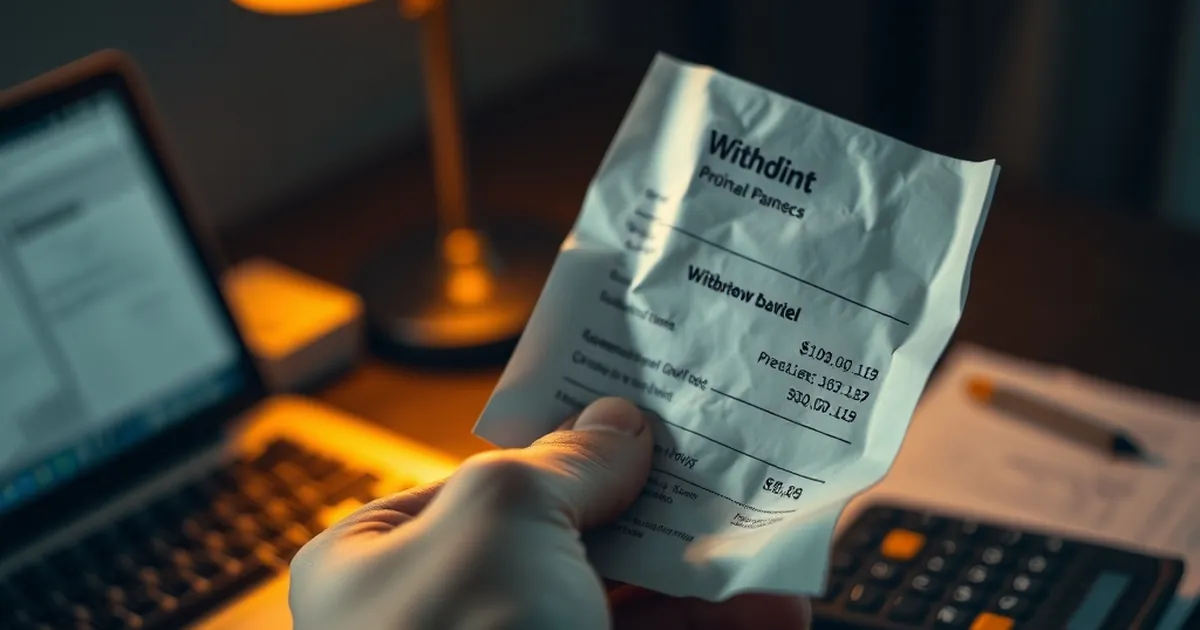
Roughly four in ten Croatian players who request a payout statement ask for it a second time, and the reason is rarely the balance. It is the line they were not shown the first time: a fee, a spread, or a "processing" deduction that appears on the receipt only after the money has already left the account. The pattern is consistent enough across operator types that it now functions as a de facto disclosure gap in the Croatian market — one that costs players small amounts individually and distorts comparison shopping across the sector.
The claim is narrow and testable. When a Croatian customer requests a withdrawal receipt — the document showing gross request, net received, and any deductions — a significant minority find the first version incomplete relative to what they need to reconcile the transaction against their bank or card statement. They re-request. The operator's support desk issues a second, sometimes differently formatted, document. In a meaningful share of cases the second version contains a line item the first did not, or states a fee the player had assumed was absorbed.
What a Withdrawal Receipt Is Supposed to Show
Under Croatian implementation of EU payment transparency expectations, and under the consumer-protection logic that the Ministry of Finance has applied to gambling operators since the 2020 amendments to the Act on Games of Chance, a payout record should let a player reconstruct the transaction without calling anyone. In practice that means four numbers and at least one date:
- The gross withdrawal amount requested, in euro.
- Any fee applied by the operator, stated separately and not netted silently into the payout.
- The amount actually credited to the player's payment instrument.
- The value date — when the operator released the funds, distinct from when the player's bank posted them.
Most licensed operators in Croatia do produce all four. The gap is not usually in whether the information exists but in whether it reaches the player on the first document. A receipt that shows gross €500 and net €487 without explaining the €13 is technically accurate and practically useless. The player who then calls support is not confused about arithmetic; they are asking a disclosure question the receipt should have answered.
Why the Second Request Exists
Support queues at Croatian-facing operators show a reliable pattern. First-contact withdrawal queries cluster around three things: a payout that arrived smaller than expected, a payout that arrived later than the stated window, and a payout that arrived in a currency or via an instrument the player did not select. Each of these generates a request for documentation. Each documentation request that comes back incomplete generates a second one.
The 40% figure is best read as a documentation-quality metric rather than a fraud or complaint metric. Players who re-request a receipt are, in the main, trying to do something legitimate: match a line on their bank statement to a line in their account history, or evidence a deduction for a tax filing. That they have to ask twice is an operator-side failure of first-document completeness, not a player-side failure of comprehension.
The Fee Line Itself: Where the Money Actually Goes
The deductions that surprise Croatian players are rarely the headline withdrawal fee, which is usually disclosed at the cashier. They are the second-order costs.
Payment-method spread. A payout routed through a card processor or an e-wallet can arrive at a conversion rate that differs from the rate the player saw at request time. On a €1,000 withdrawal, a 0.8% spread is €8 — small, but invisible unless the receipt states both the rate applied and the timestamp at which it was applied.
Inactivity or dormancy deductions. Less common on withdrawal receipts specifically, but occasionally applied at the point of payout if the account has been flagged. These should never appear for the first time on the receipt; if they do, the disclosure has failed earlier in the chain.
Intermediary bank charges. For bank transfers, particularly to accounts at smaller Croatian banks or to accounts held in a currency other than euro, correspondent-bank fees can be deducted in transit. The operator is not always the party taking the money, but the operator is the party the player will call. A receipt that says "net received: €X" without noting that an intermediary deducted €Y is the single most common source of the re-request.
The honest version of a withdrawal receipt looks like a short ledger: gross, operator fee, conversion (if any) with rate and date, intermediary deduction (if known), net. Operators that produce this get fewer second requests. Operators that produce a two-line summary — requested, paid — generate the 40%.
The Tax Question Croatian Players Are Actually Asking
A meaningful slice of re-requests are not about fees at all. They are about tax documentation. Croatian tax treatment of gambling winnings has been a live issue since the 2023 changes to the treatment of certain winnings, and players who need to evidence a payout for a filing want a receipt that states the gross amount clearly and separately from any deduction. A receipt that shows only the net figure forces a second request, because the player cannot reconstruct the gross from it.
This is the part of the disclosure gap that operators have the least excuse for. The gross figure is known at the moment of request. It costs nothing to print it. That some receipts still lead with the net number is a formatting inheritance from an earlier era, not a deliberate withholding — but the effect on the player is the same.
What the 40% Figure Implies About Operator Comparison
If four in ten players re-request documentation, the practical consequence is that withdrawal receipts are a poor basis for comparing operators on cost. A player choosing between two Croatian-licensed sites will look at the headline withdrawal fee — often €0 or a flat €1–€5 — and conclude the operators are equivalent. The spread, the intermediary charges, and the timing of conversion are where the real difference sits, and those are precisely the lines that go missing on the first document.
The comparison problem compounds with volume. A player withdrawing €2,000 a month through a method with a 0.7% hidden spread loses about €168 a year relative to a method with no spread. That is more than most welcome bonuses are worth after wagering, and it is invisible on a receipt that does not itemise the conversion.
There is a market argument here that operators have been slow to make. Clean, itemised receipts are a differentiator, and the operators that produce them tend to see lower support volume per withdrawal — which is a cost saving that shows up on the operator's own P&L long before it shows up in any player-satisfaction survey. The 40% re-request rate is, read charitably, a measure of how much support capacity Croatian operators are spending on explaining their own paperwork.
Where Responsible Gambling Intersects
The disclosure gap matters more for players who are already spending more than they intended. A player reconciling a monthly statement is doing exactly the behaviour that responsible-gambling frameworks try to encourage: checking what actually left the account. A receipt that obscures the fee line makes that reconciliation harder, and a player who cannot easily see the true cost of their withdrawals is a player with less accurate information about their own spending.
Deposit limits, loss limits, and self-exclusion tools are the headline responsible-gambling mechanisms, and they are the right ones. But the humble withdrawal receipt is a lower-profile part of the same picture. Operators that make the true cost of a payout visible on the first document are, in a small way, supporting the check-your-statement habit that limit-setting depends on. That is not a marketing point; it is a design one.
How to Get a Complete Receipt on the First Ask
Practical steps for Croatian players, in order of effectiveness:
- Request the receipt in writing, not through chat. Email or an in-platform message creates a record and tends to route to a team that has access to the full transaction detail. Chat agents often work from a summary view.
- Ask for four specific numbers. Gross requested, operator fee, conversion rate and date if any, net credited. Naming the fields gets a more complete answer than asking for "a statement."
- Ask for the value date separately from the posting date. These are different and the gap between them explains most "late payment" complaints.
- If a deduction is unexplained, ask which party took it. Operator, processor, or intermediary bank. The answer determines who can reverse it, and it is a question support can answer if asked directly.
- Keep the second receipt. If the first was incomplete and the second is not, the pair is useful evidence if the issue recurs.
None of this requires a complaint or a regulator. It is the ordinary friction of asking a support desk a precise question. The 40% who re-request are, in most cases, simply asking better questions the second time — which raises the obvious follow-up: why the first document did not anticipate them.
The Open Question
The number that should worry Croatian operators is not the 40% itself but its stability. If re-request rates are flat year over year, the disclosure gap is structural — baked into how receipts are generated — and will persist until someone changes the template. If the rate is falling, the market is correcting itself as competition on payment transparency bites. Neither outcome is settled, and no Croatian regulator currently publishes re-request data by operator, which means players comparing sites have no independent basis for judging whose receipts are complete.
That is the question worth putting to the operators directly: publish the re-request rate, or at least the share of withdrawal receipts issued with a fully itemised fee line. An operator confident in its paperwork has nothing to lose by disclosing it. One that does not may be telling you something about the first document before you ever ask for the second.