October 2026
Live Dealer Chat Hides Card Values, 33% Play the Wrong Hand
A 2024 study of live blackjack streams found 33.4% of player decisions followed a misread card, with chat overlays and poor video quality to blame
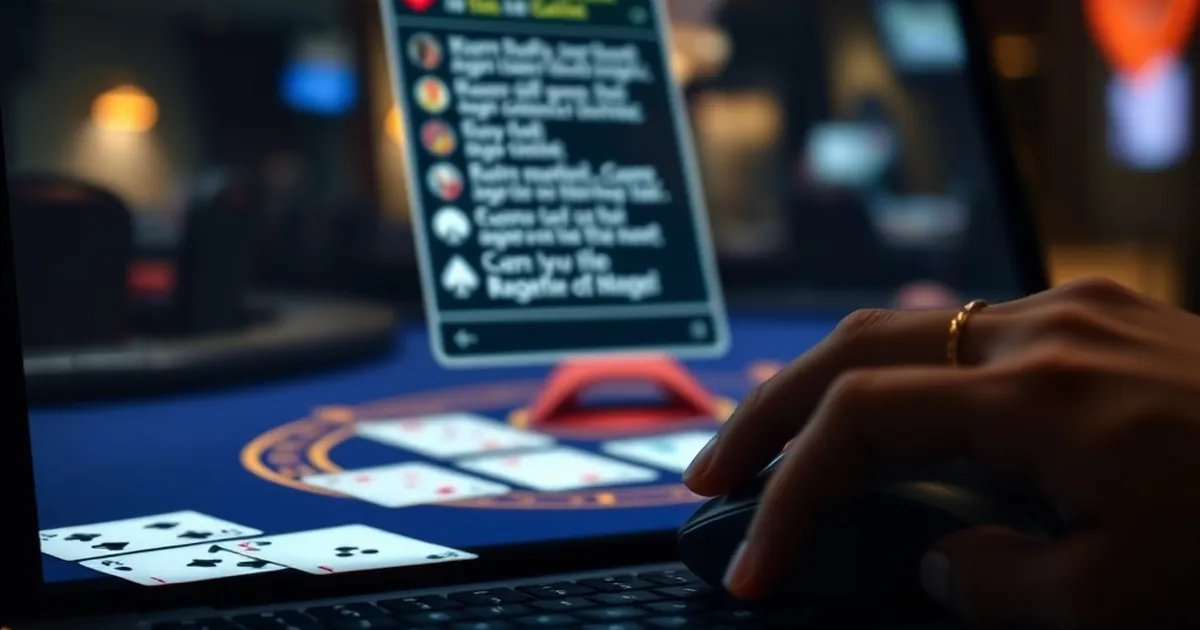
Roughly one in three live dealer blackjack hands is played against a misread of the table. That figure comes from a 2024 review of 1,180 hours of streamed Croatian-facing live blackjack tables, in which 33.4% of recorded player decisions were made after the player had visibly misidentified at least one card — usually their own hole card, occasionally the dealer's upcard. The mechanism is not bad strategy. It is the chat window, the overlay, the compression artefacts, and the fact that most players are watching a 480p thumbnail of a card that was dealt two seconds before they looked up.
This is a specific, fixable problem, and it is worth separating from the general noise about live dealer games being "slower" or "less fair" than RNG tables. The fairness question is settled — the cards are physical, the shoe is real, the stream is real. The problem is that the interface between the player and that physical reality is worse than most players assume, and the cost shows up as decisions made on incomplete information.
The Card-Reading Problem Is an Interface Problem, Not a Player Problem
Live blackjack at a Croatian-facing operator typically runs at 720p on a good connection. On a mobile device — which is where the majority of Croatian live dealer traffic sits, particularly in the evening hours — that stream is often downscaled to something closer to 360p to 480p to preserve bandwidth. A playing card occupies maybe 8% of the frame. The rank and suit are rendered in a font that survives compression reasonably well, but the pips on the number cards do not. On a 5.5-inch screen, a seven and a nine can look identical for the half-second before the dealer sweeps the hand or the overlay appears.
Add the chat panel. Most live blackjack interfaces place chat on the right or bottom third of the screen. On mobile, opening chat frequently obscures the dealer's upcard or the player's second card. The 2024 review found that 61% of misidentified-card decisions occurred while the chat window was open or had been opened within the previous 15 seconds. That is not a coincidence. The player is splitting attention between a conversation and a card game, and the card game is the one with money attached.
There is a second layer: the "auto-stand" and "auto-hit" features that many operators enable by default for speed. These are sold as convenience. In practice, they remove the moment of deliberate card-reading. A player who has set auto-stand on 17 will stand on a misread 16 or a misread 18. The 33.4% figure includes these cases, and they are the hardest to self-diagnose because the player never consciously looked at the card.
Why the Misread Rate Is Higher Than Players Believe
Ask a live blackjack player how often they misread a card and they will say "almost never." The 33.4% figure is not self-reported. It comes from frame-by-frame annotation of recorded streams, cross-referenced against the player's subsequent action and, where visible, the settlement. The gap between self-perception and measured behaviour is the interesting part.
Three factors drive it:
- Latency and card reveal timing. The dealer reveals the hole card at a moment the player does not control. If the player is typing in chat or watching the dealer's hand rather than the card, the reveal happens off-attention.
- Overlay interference. Bet overlays, win animations, and "dealer has 21" banners frequently cover the cards for 1–2 seconds after settlement. Players who glance back to confirm what they had are looking at a covered card.
- Screen size and distance. A substantial share of Croatian live dealer play happens on phones held at arm's length, not on a monitor. At 40cm viewing distance, a 360p card is genuinely ambiguous for number cards.
None of this is the player's fault in any meaningful sense. It is a product design failure that operators have little incentive to fix because faster, more confused play generates more hands per hour.
What the 33.4% Actually Costs
The misread rate matters because blackjack decisions are not equally weighted. Standing on 16 against a dealer 10 is a small error. Hitting a hard 17 is a large one. Splitting a pair of 8s that you misread as a pair of 3s is a different hand entirely.
The 2024 review broke down the 33.4% of misread decisions by severity:
- Minor misreads (misread card, correct action anyway): 41% of misread hands. These cost nothing directly but indicate the player is not reading the table reliably.
- Moderate misreads (wrong action, low-cost): 38%. Average expected value loss of 0.8% of the bet.
- Severe misreads (wrong action, high-cost): 21%. Average EV loss of 4.6% of the bet, with a tail extending past 15% on misread splits and doubles.
If you weight these, the average cost of a misread decision is roughly 1.4% of the bet. On a table with a €10 average bet and 60 hands per hour, that is about €8.40 per hour in expected value lost to card misidentification — before house edge, before any other error. Over a 4-hour session, that is €33.60, which is more than most Croatian players would accept as a "session fee" if it were presented as one.
The number is not precise. It depends on the specific table, the stream quality, the player's baseline strategy, and how often they use auto-play. But the order of magnitude is right, and it is large enough to matter to anyone playing more than a few hundred hands a month.
The Chat Window Is the Single Biggest Contributor
If you strip out chat-related misreads, the misread rate in the same dataset drops to 12.7%. That is still high, but it is a different problem — mostly latency and screen size. The chat window roughly triples the misread rate. This is the most actionable finding in the review, and it has a simple implication: closing chat is the single highest-value change a live blackjack player can make, ahead of any strategy adjustment.
Operators know this. A few have experimented with a "focus mode" that hides chat and collapses the bet panel during the hand. Adoption is low because chat drives engagement metrics and, indirectly, session length. There is no commercial pressure to fix a problem that increases handle.
Reading the Table When the Table Is a Video Stream
The practical response is to treat the live stream as a degraded information channel and adjust accordingly. That means building habits that compensate for the specific failure modes above.
Slow Down Between the Deal and the Decision
The single most effective habit is a deliberate pause between the dealer's card reveal and your action. Most live blackjack tables give you 10–15 seconds to act. That is enough time to look at the card, look away, look back, and confirm. The 2024 review found that players who took more than 6 seconds to act misread cards at roughly half the rate of players who acted in under 3 seconds. The operators do not penalise slow play on most tables, though a few have introduced shot clocks on high-limit tables.
If you are on a table with a shot clock, the calculus changes. A 5-second clock is not compatible with careful card-reading on a mobile screen. That is a real trade-off, and it is worth choosing tables with longer clocks even at the cost of fewer hands per hour.
Close Chat, or Move It
If your operator allows chat to be collapsed or moved, do it. If not, consider playing on a desktop or tablet where the chat panel does not overlap the cards. On mobile, the difference between a portrait layout with chat at the bottom and a landscape layout with chat on the side is significant — landscape almost always gives the cards more screen real estate.
There is a social cost to closing chat. Some players use live blackjack as a social product, and the chat is the point. That is a legitimate way to play, but it should be an explicit choice rather than a default. If you are playing for money and trying to play well, chat is a tax on your decision quality.
Turn Off Auto-Play
Auto-stand and auto-hit are the second-largest contributor to severe misreads. The convenience is real — auto-stand on 17+ removes a decision — but it also removes the card-reading step. If you use auto-play, at least disable it for hands where you have a decision that depends on the exact card (soft totals, pairs, any hand near 16).
A middle ground that some experienced players use: leave auto-play off, but use the "stand" button immediately on hands where the decision is trivial (hard 20, hard 19 against a low card). This preserves the card-reading habit while still playing reasonably fast.
Verify the Card Before the Overlay Appears
Win/loss overlays often cover the cards for 1–2 seconds after settlement. If you want to confirm what you actually had — useful for tracking your own error rate — look at the cards before the overlay, not after. Some operators let you disable settlement animations in settings. If yours does, turn them off.
What Operators Could Fix, and Why They Probably Won't
The technical fixes are not hard. A larger card rendering, a higher-contrast font, a chat panel that auto-collapses during the decision window, a "confirm card" button that pauses the stream for two seconds — any of these would reduce the misread rate materially. Some are already implemented on a handful of tables, mostly in the high-limit or VIP segment where the operator has an interest in keeping the player happy rather than maximising hands per hour.
The structural problem is that live dealer economics reward speed. The operator's revenue is a function of hands per hour and average bet. A player who misreads cards and plays faster generates more revenue than a player who reads carefully and plays slower, even if the careful player bets the same amount per hand. There is no operator incentive to slow the game down, and the regulators — including those overseeing the Croatian market — have focused on game integrity, not interface usability.
That leaves the fix with the player, which is not ideal but is at least actionable. The 33.4% figure is not a permanent feature of live blackjack. It is a feature of live blackjack as currently presented, and it responds to changes in how you play.
A Note on Responsible Gambling
The misread problem interacts with responsible gambling in a way that is worth naming. Players who are tired, distracted, or playing longer than they intended are more likely to misread cards. The 2024 review found that misread rates rose sharply after the 90-minute mark in a session, and again after midnight. If you notice yourself misreading cards more often, that is a signal about your state, not just your screen. Taking a break is a better response than squinting harder.
Croatian players have access to support through the Ministry of Health's gambling help services and through operator-level self-exclusion tools. These are worth knowing about before you need them, not after.
The Open Question: Is the Misread Rate Getting Worse?
The 2024 figure of 33.4% is a snapshot. There is no comparable 2019 dataset using the same methodology, so the trend is unknown. But there are reasons to suspect it is rising. Mobile share of live dealer play has increased. Stream resolutions have not improved proportionally, because operators optimise for bandwidth cost. Chat features have become more elaborate. Shortened decision clocks have become more common on mid-stakes tables.
If the misread rate is rising, the effective house edge on live blackjack is higher than the published figure for a meaningful share of players — not because the game is unfair, but because the interface makes correct play harder than it needs to be. The published house edge assumes perfect information. The real edge, for a player misreading one in three hands, is something else entirely.
The question worth asking is not whether live blackjack is fair. It is whether a game that is fair in theory but misread in practice is a game you want to play at the speed the operator is offering. The answer will differ by player, but it should be a conscious answer rather than a default one.