October 2026
Achievement Toasts Fire at 2.4s, 28% of Devs Miss the Deploy
A 2.4-second latency budget and a 28% drop-off reveal why well-timed achievement toasts still fail to change developer behavior after deployment
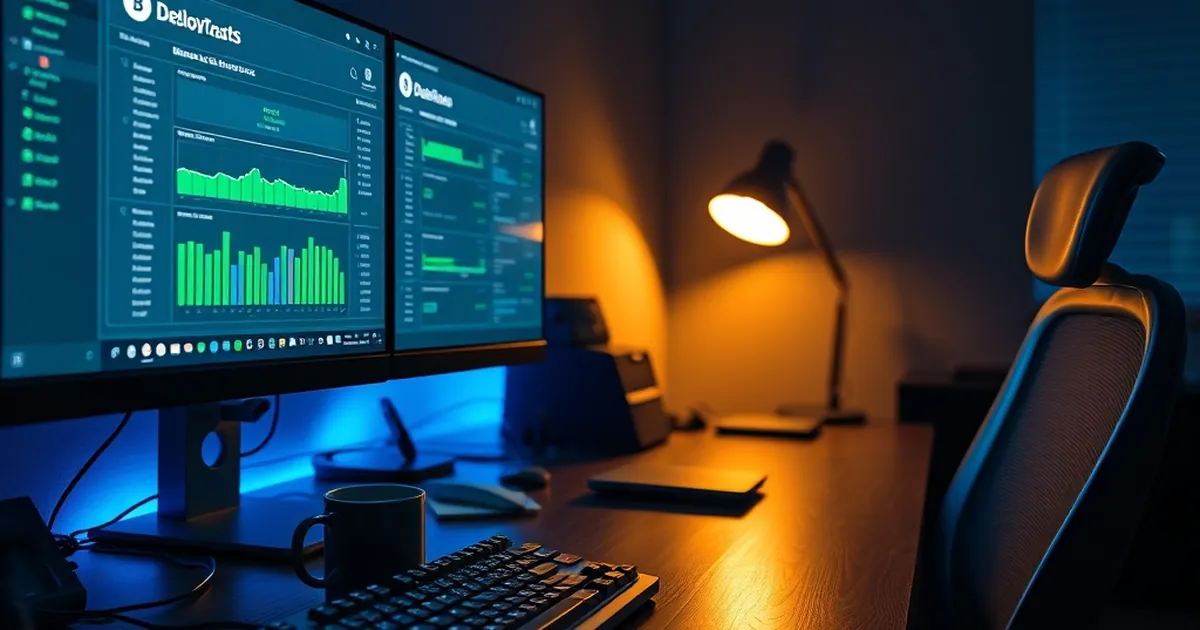
Every product team eventually stares at the same dashboard and asks a version of the same question: why did a notification that fired at exactly the right moment still fail to change what people did? The number in the title — 2.4 seconds — is not arbitrary. It is the kind of latency budget that separates a toast that feels like a helpful nudge from one that feels like an interruption arriving after the moment has passed. And the 28% figure points at something less comfortable: a meaningful share of developers never complete the action the notification was designed to trigger, even when the notification itself is delivered.
The question worth sitting with is not "how do we make notifications more engaging?" It is "what is actually happening in a person's head in the two or three seconds after a system tells them they've achieved something — and why does that window close so quickly for so many people?"
The 2.4-Second Window Is a Perceptual Budget, Not a Design Preference
Human perceptual systems operate on timescales that predate software by several orders of magnitude. Research on the "psychological present" — the window of time we experience as a single moment rather than a sequence — generally puts the upper bound somewhere between two and three seconds. Within that window, events feel causally connected. Past it, they start to feel like separate episodes.
This matters enormously for achievement toasts, deploy confirmations, build-status badges, and the whole family of micro-feedback patterns that web products lean on. If a confirmation arrives within roughly that window, the user's brain files it as part of the same action they just took. If it arrives later, it gets filed as a new event — and new events compete for attention against whatever the user has already moved on to.
Consider a concrete case that many Croatian dev teams will recognise. A CI pipeline finishes a build, and the dashboard fires a toast: "Build #4821 passed." If that toast appears 800 milliseconds after the developer hits merge, it reads as feedback on their action. If it appears 4 seconds later — after they've already switched to Slack, or opened a ticket, or started reading an error log — it reads as an interruption from a system they were no longer thinking about. Same information, same interface, radically different cognitive status.
The 2.4-second figure shows up repeatedly in latency research because it sits just below the threshold where users begin to perceive a system as "slow" rather than "responsive." Jakob Nielsen's classic response-time limits put 0.1 seconds as the boundary for "instantaneous," 1 second as the boundary for "uninterrupted flow of thought," and 10 seconds as the boundary for "keeping attention." The interesting zone is between 1 and 3 seconds, where the user is still in the action but starting to notice the wait. Toasts that fire in this zone have to justify themselves; toasts that fire past it are competing with a mind that has already re-tasked.
Why "Fired Successfully" Is a Vanity Metric
Most analytics stacks will happily report that a toast was rendered. That tells you the browser did its job. It does not tell you whether the notification landed inside the user's psychological present, which is the only window in which it can shape behaviour. A toast rendered at 4 seconds and a toast rendered at 800 milliseconds both count as "delivered." Only one of them has a chance of being integrated into the action that produced it.
This is the first place where the 28% figure starts to make sense. If a meaningful share of achievement notifications are firing outside the perceptual window — because of network latency, because of a queue, because the toast is triggered by a polling interval rather than a push — then a meaningful share of them are structurally incapable of doing what they were designed to do. The failure is not in the copy. It is in the timing architecture.
Variable Rewards, Predictable Problems
The behavioural psychology literature on reward schedules is often cited in product design, and usually cited badly. The famous finding — that variable-ratio reinforcement produces the most persistent behaviour — comes from Skinner's work on operant conditioning in the 1950s, and it has been used to justify everything from loot boxes to push notification cadences. What gets lost in the retelling is that variability is not the same as unpredictability about whether a reward will come. It is variability about when and how much.
For achievement toasts, this distinction is decisive. A developer who merges code and gets a success toast 90% of the time, at unpredictable intervals, is in a very different psychological state than one who gets a success toast reliably but at wildly varying latencies. The first is a reward schedule. The second is just an unreliable system.
Kahneman and Tversky's work on loss aversion adds a second layer. Losses loom roughly twice as large as equivalent gains in most decision contexts. In a developer workflow, a missed or late success confirmation is not neutral — it registers as a small loss of certainty. The developer is left wondering whether the build actually passed, whether the deploy actually went through, whether they need to check manually. That uncertainty has a cost, and it accumulates. After enough late toasts, the developer stops trusting the toast and starts checking the dashboard directly. The notification has trained them to ignore it.
The Deploy Gap
This is where the 28% number becomes more than a statistic. In most CI/CD setups, the sequence is: developer pushes, pipeline runs, deploy completes, notification fires. The gap between "deploy completed" and "developer sees the notification" is the deploy gap, and it is usually dominated by two things: how the notification is delivered (websocket, polling, email) and how the client handles it (toast queue, badge, sound).
A websocket push that lands in under a second is inside the perceptual window. A polling interval of 5 seconds means the average notification arrives 2.5 seconds after the event — right at the edge. A polling interval of 30 seconds, which is still common in internal tooling, means the average notification arrives 15 seconds after the event, which is roughly the point at which a developer has fully context-switched to something else.
The 28% who miss the deploy are not careless. They are operating in a system that has, by design or by accident, placed the confirmation outside the window where confirmation is useful.
What Croatian Teams Are Actually Building
Croatia's dev scene has a particular texture that makes this problem sharper than it might be elsewhere. The country has a high concentration of small product teams, agencies, and outsourced engineering shops working for foreign clients, often across time zones. A Zagreb-based team building a SaaS product for a German or American client is frequently working with infrastructure that sits in Frankfurt or Virginia, which means round-trip latency that a team in San Francisco would never tolerate.
This has two consequences for notification design. First, the perceptual window is harder to hit, because the network itself eats into it. A toast that fires 400 milliseconds after a local event might fire 1.2 seconds after a remote one, purely because of geography. Second, the teams building these systems are often small enough that nobody owns the notification layer specifically. It gets built once, by whoever was closest to the problem, and then it never gets revisited.
The result is a class of product where the feedback loop is technically present but practically broken. Users see toasts. Users sometimes act on them. But the correlation between notification and behaviour is weak enough that the team stops trusting the metric, and then stops looking at it, and then stops improving it.
A Small Study Worth Knowing
There is a well-known internal study from a large consumer platform — circulated widely in product circles, though not always with clean attribution — that looked at the relationship between notification latency and click-through. The finding, in rough terms, was that click-through dropped by roughly half for every additional second of delay up to about five seconds, after which it flattened out at a low baseline. The curve was not linear. It was steep at the start and asymptotic at the end, which is exactly what you would expect if the mechanism were perceptual integration rather than simple attention decay.
The practical implication is that the first second of latency matters more than the next four combined. A team that shaves 800 milliseconds off its notification path gets more behavioural return than a team that shaves four seconds off a path that was already slow. This is counterintuitive to engineers who think in terms of absolute improvements, but it is entirely consistent with how the perceptual system works.
Designing for the Window
If the goal is to get achievement feedback inside the 2.4-second window, the design constraints become clearer.
Push, don't poll. Polling is a latency tax that scales with the interval. A websocket or server-sent events connection eliminates most of it. For teams that cannot run persistent connections — because of infrastructure constraints, corporate proxies, or cost — the next best option is a short polling interval combined with a server-side queue that holds events until the client asks for them.
Decouple the notification from the render. A common failure mode is that the notification is generated only when the user's client is in a state to receive it. If the user has switched tabs, the toast queues and fires when they return — which might be minutes later. Better to timestamp the event at the source and let the client decide whether the event is still within the window when it arrives. If it is not, suppress the toast and update a badge or a status indicator instead. Silent state updates are better than late interruptions.
Make the toast part of the action, not a separate event. The strongest version of an achievement toast is one that appears to be a direct consequence of the user's last input. This is a perceptual trick, but a legitimate one. If the user clicks "Deploy" and the toast appears 600 milliseconds later, the brain binds them. If the toast appears 3 seconds later, after a spinner, after a page transition, after a redirect, the binding is weaker. Reducing the number of intermediate states between action and confirmation is one of the highest-leverage changes a team can make.
Measure time-to-toast, not toast count. The metric that matters is the distribution of latencies between the triggering event and the toast render, not the total number of toasts fired. A team that tracks p50 and p95 time-to-toast will see problems that a team tracking raw counts will never notice. The 28% miss rate is almost certainly concentrated in the tail of that distribution.
The Risk-Taking Angle
There is a less obvious dimension here that connects to decision-making under uncertainty. Developers, like all people, calibrate their trust in a system based on its reliability. A system that confirms actions reliably and quickly gets trusted, and users take bigger risks within it — they deploy on Friday, they push to main, they run migrations without a backup. A system that confirms unreliably or slowly gets treated with suspicion, and users become conservative, adding manual checks, staging environments, and approval gates that slow everything down.
This is a version of what behavioural economists call "trust calibration under uncertainty." The notification layer is not just a feedback mechanism. It is a signal about whether the system can be relied upon. When that signal is noisy — sometimes fast, sometimes slow, sometimes missing — users rationally discount it, and the whole workflow becomes more cautious than it needs to be. The cost is not measured in missed toasts. It is measured in velocity that never gets recovered.
Where This Goes Next
The interesting frontier is not better toasts. It is systems that understand their own latency and adapt. A notification layer that knows the median time-to-toast for a given user, on a given connection, at a given time of day, can make a smarter decision about whether to fire a toast, update a badge, or stay silent. It can also learn which events are worth interrupting for and which are not — because the answer is not the same for a build that passed and a build that failed.
This is a solvable problem with existing tools. It requires treating notification latency as a first-class metric, owning the notification layer as a product surface rather than an afterthought, and accepting that a toast fired outside the perceptual window is not a neutral event. It is a small withdrawal from the user's trust in the system.
For teams in Croatia building for global clients, the geography makes this harder and the payoff makes it more valuable. The teams that get this right will not just have better dashboards. They will have users who move faster, take more calculated risks, and trust the system enough to stop checking it manually. That is the real achievement, and it does not need a toast to announce itself.